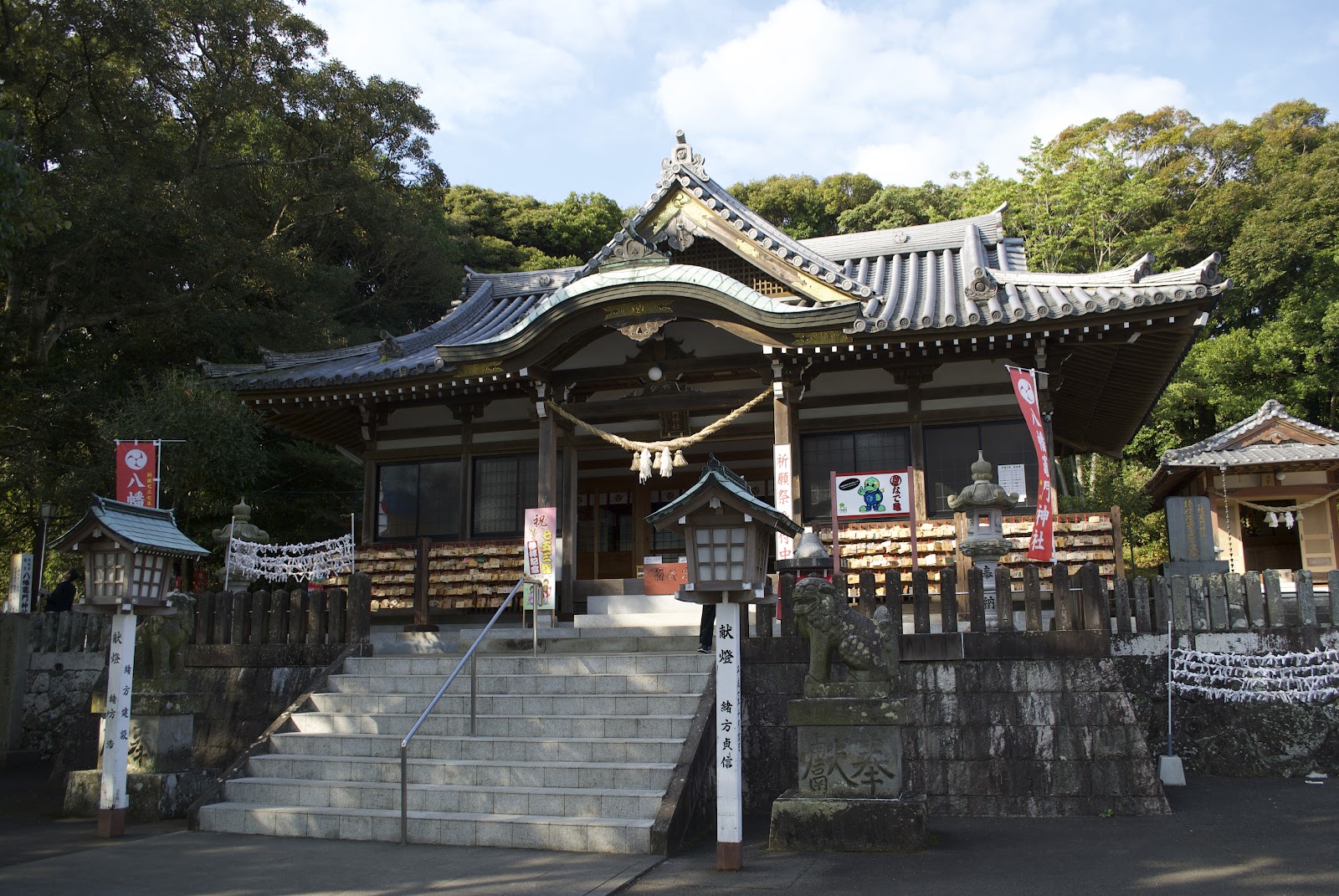
Over the years, Beppu has become a new pilgrimage destination for Demon Slayer fans, centered on Hachiman Kamado Shrine and the Jigoku Meguri (Hell Tour). Real naval mines beside the shrine gate, a red demon statue half-hidden in hot spring steam — walk through Hachiman Kamado Shrine and Kamado Jigoku, and you may feel as if you’ve stepped into a scene from the story. Demons, dragons, and kagura (sacred dance) motifs that echo the series turn up all over, which is a big part of the appeal. This guide covers it all: the links to the series you can find on the shrine grounds, how to pair your visit with the Hell Tour, and the practical details you’ll need along the way.
Why Is Beppu a “Demon Slayer” Pilgrimage Site?
Demon Slayer follows Tanjiro Kamado, whose family is killed by demons, as he sets out to turn his younger sister Nezuko — who has been turned into a demon — back into a human. So it’s no surprise that a shrine in Beppu bearing the very same surname, Kamado, caught fans’ attention. To be clear, this is not an official collaboration. The pilgrimage culture here grew out of a shared name.
The History of Hachiman Kamado Shrine
Hachiman Kamado Shrine stands on Mt. Kameyama in the Uchikamado district of Beppu. For generations, locals have come here to pray for the safety of their households and protection from misfortune.
What Fans Notice: Links to Demon Slayer
The shrine grounds are dotted with demons, dragons, kagura, and other motifs that call to mind the world of Demon Slayer. Here are the highlights to look for on your pilgrimage.
The legend of the stone steps: The god Hachiman made a man-eating demon promise: “If you cannot build 100 stone steps in a single night, never show yourself in this village again.” The demon had laid 99 steps when dawn broke and a rooster crowed, so it vanished with the stairway unfinished. This legend featuring a man-eating demon is one of the things that call to mind the Demon Slayer world.
The white dragon on the ceiling: A white dragon is painted on the ceiling of the worship hall, and its resemblance to Tanjiro’s Water Breathing technique has drawn attention.
New Year’s Eve kagura: Every New Year’s Eve, the shrine holds a performance of Kamado Kagura, a sacred dance offered to the gods. The name itself brings to mind the Hinokami Kagura (Dance of the Fire God) from the series.
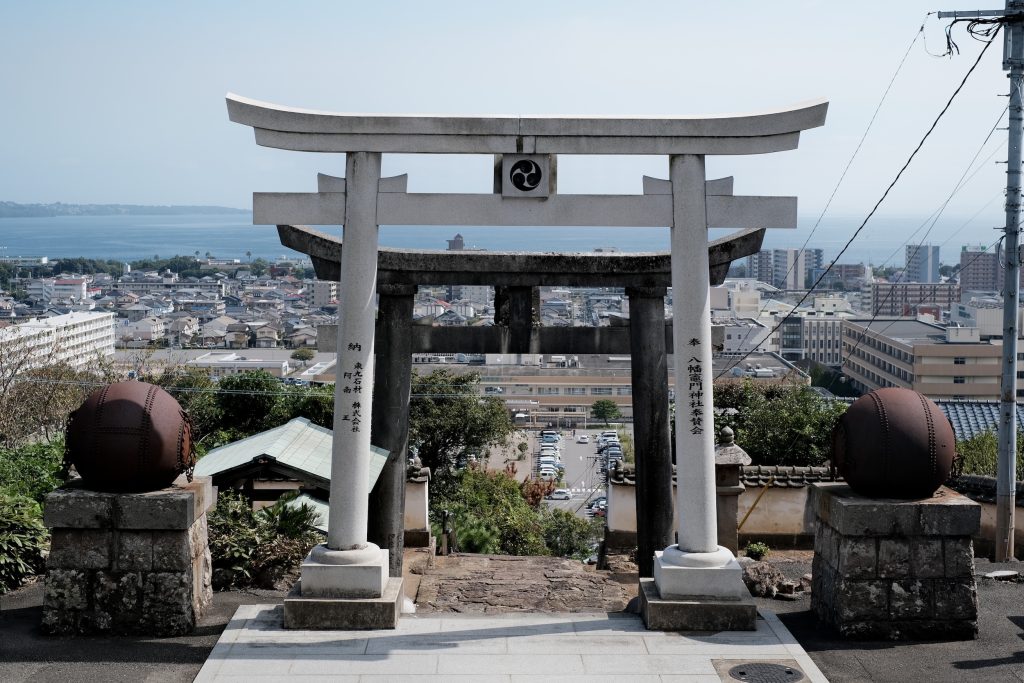
The naval mines at the torii gate: The objects on either side of the torii gate are real naval mines, donated around 1928 by a former member of the Japanese Navy from the Kamegawa area to commemorate Japan’s victory in World War I. Some fans say their rugged iron finish recalls the weapons of the Demon Slayer Corps.
The sacred Tamayori tree: Its name, Tamayori, reminds some fans of Tamayo, a character from the series.
Charms and ema: At the shrine office, the patterns on the charms have attracted attention for their resemblance to Tanjiro’s and Nezuko’s haori jackets. At the ema (wooden prayer plaque) rack, rows of fan-drawn character illustrations make it a popular photo spot.
Hunting for these coincidences with the characters is half the fun, but this is still a historic shrine and a place of worship for the local community. When taking photos, please be careful not to get in the way of local people who have come to pray.
Other Related Spots
Jigoku Meguri (Hell Tour)
Beppu’s Jigoku Meguri is a sightseeing route through hot spring areas formed by volcanic activity. Since ancient times, people in Beppu have called the springs that spout steam, boiling mud, and scalding water jigoku (hell). Landscapes once feared and avoided have since been developed into some of Beppu’s best-known attractions.
Kamado Jigoku (Cooking Pot Hell): The Hell Linked to Hachiman Kamado Shrine
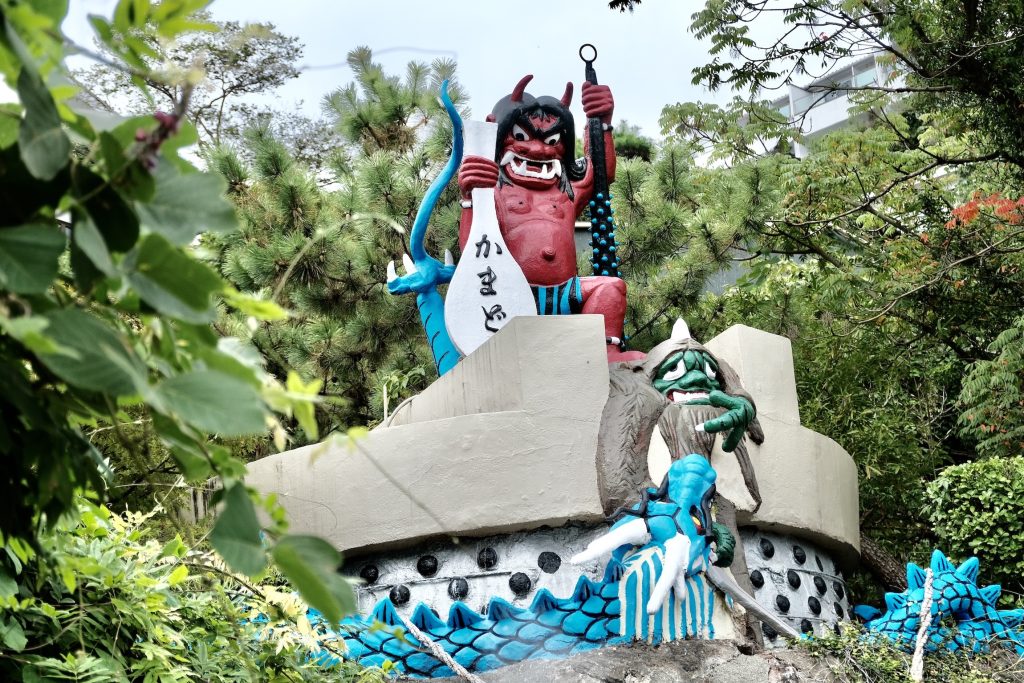
Kamado Jigoku gets its name from a local festival: the steam from this hot spring was used to cook the rice offered to the gods, and that festival itself originated at Hachiman Kamado Shrine. There’s also a legend that the demon from the shrine’s stone-step story mended its ways and became the gatekeeper of Kamado Jigoku. The demon statue at Kamado Jigoku’s Kamado 2-chome area keeps that story alive today.
Practical info: Open 8:00 AM to 5:00 PM, every day of the year. Admission to Kamado Jigoku is ¥500 for adults and ¥250 for children (elementary and junior high school students) (revised February 2025). If you plan to visit other hells such as Chinoike Jigoku, the combined ticket for all 7 sites (¥2,400 for adults, ¥1,200 for children; valid for 2 days — the day of purchase and the next day) is the better deal. Prices may change, so check the official website for the latest fees before you go. By car, it’s about 20 minutes from JR Beppu Station and about 10 minutes from JR Kamegawa Station.
Chinoike Jigoku (Blood Pond Hell): A Crimson Hell That Echoes the Series
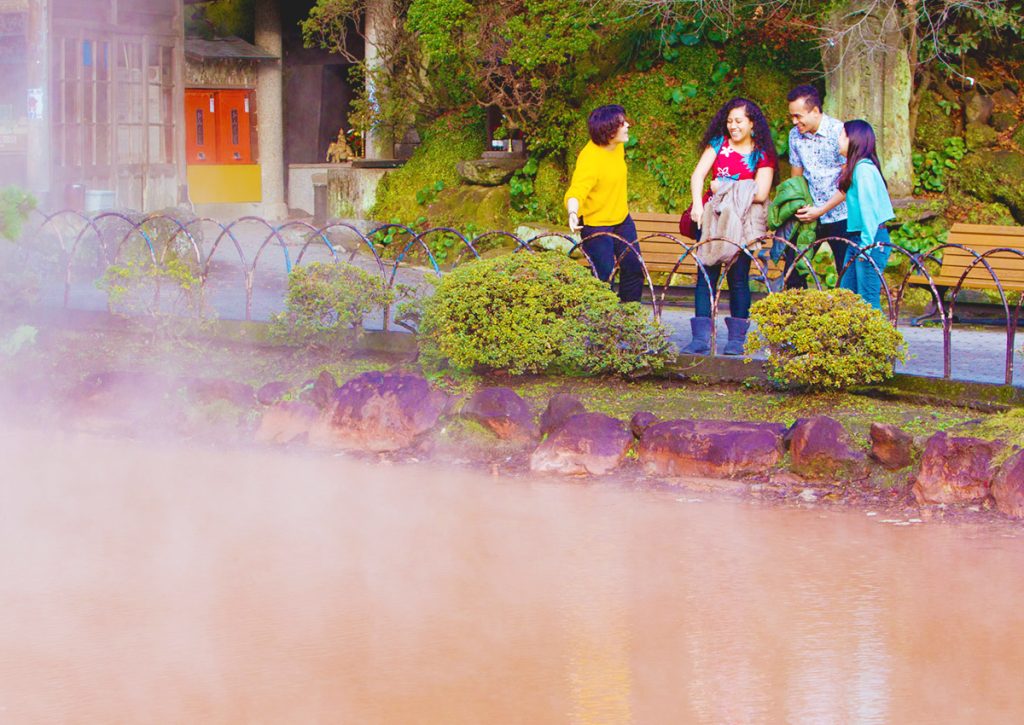
Chinoike Jigoku, where red mud and hot water bubble up from the ground, is known as Japan’s oldest natural jigoku. Its deep-red landscape fits right into a trip built around the world of Demon Slayer.
Practical info (Chinoike Jigoku): Open 8:00 AM to 5:00 PM, every day of the year. Admission to Chinoike Jigoku is ¥500 for adults and ¥250 for children (elementary and junior high school students) (revised February 2025).
*Prices are subject to change. Please check the official website for the latest information before your visit.
Sample Route: From Hachiman Kamado Shrine to the Hell Tour
If you’re driving, head to Kamado Jigoku after visiting Hachiman Kamado Shrine — it’s about 8 minutes away by car. Along the way, you can follow the local legend of the demon who built the shrine’s stone steps and later became the gatekeeper of Kamado Jigoku. Continue on to Chinoike Jigoku, and you’ll get to enjoy both scenery that recalls the series and the jigoku unique to Beppu.
Access: Getting There from Beppu Station and Kamegawa Station
You can reach each spot from Beppu Station by the local buses listed in the table below. To travel between all three spots, you can also take Kamenoi Bus Route 29, which links Uchikamado Iriguchi (the nearest stop to Hachiman Kamado Shrine), Chinoike Jigoku-mae, and the Kannawa area, where Kamado Jigoku is located. Buses on this route run infrequently, though, so if you’re getting around by public transportation, check the latest timetable and plan ahead. If saving time is your priority, traveling by car or taxi is more convenient.
| Destination | By car | By bus |
|---|---|---|
| Hachiman Kamado Shrine | About 15 min from JR Beppu Station; about 10 min from JR Kamegawa Station | From Beppu Station, take Kamenoi Bus Route 26 or 26A (Outer Loop Line) to Uchikamado Iriguchi, then walk for 10 min |
| Kamado Jigoku | About 20 min from JR Beppu Station; about 10 min from JR Kamegawa Station | From JR Beppu Station West Exit, take a bus via Kannawa (Routes 1, 2, 5, 7, or 41) to Kannawa, then walk for 8 min |
| Chinoike Jigoku | About 20 min from JR Beppu Station; about 5 min from JR Kamegawa Station | From Beppu Station, take Kamenoi Bus Route 26 bound for Kannawa to Chinoike Jigoku-mae; it’s right by the stop |
Beppu Hatto: An Onsen Trip for Demon Slayer Fans
Beppu is one of Japan’s leading onsen destinations, made up of eight distinctive hot spring districts known as Beppu Hatto. The city has 2,831 hot spring sources producing about 101,856 liters of water per minute (as of the end of March 2025). After your Demon Slayer pilgrimage, head out to onsen areas such as Kannawa or Kankaiji — each with its own character — and end your trip by relaxing in the hot springs, just as the story’s heroes would.
For more on the Hell Tour’s connections to Demon Slayer, see our article A Demon Slayer–Inspired Journey Through Beppu.
FAQ
Q1. Is Hachiman Kamado Shrine officially connected to Demon Slayer?
— No official collaboration or licensing deal has been confirmed. The shrine naturally became a pilgrimage site among fans because its name, Kamado, matches the main character’s family name.
Q2. Can I visit Hachiman Kamado Shrine and Kamado Jigoku on the same trip?
— Yes. They’re about 8 minutes apart by car, and the pairing is a popular route that connects the legend of the stone steps with the demon legend of Kamado Jigoku.
Q3. How much does the Hell Tour cost?
— Following the February 2025 price revision, admission to each hell is about ¥500 for adults and ¥250 for children. If you plan to visit several, the combined ticket for all 7 sites (¥2,400 for adults, ¥1,200 for children) is the better deal. Check the official website for the latest prices.
The Hell Tour is also included in the Beppu Shuyu Pass, which covers 18 attractions across the city, including Beppu Cable Rakutenchi and Kijima Kogen Park. It comes as a 1-day pass (¥3,800 for adults, ¥2,500 for children) or a 2-day pass (¥6,000 for adults, ¥3,500 for children) — a handy option if you want to combine the Hell Tour with other sightseeing. The QR-code e-ticket can be purchased on the official Beppu Tabi Kobo website. Since September 2025, paper tickets have also been available at WANDER COMPASS BEPPU, the tourist information center at Beppu Station.